
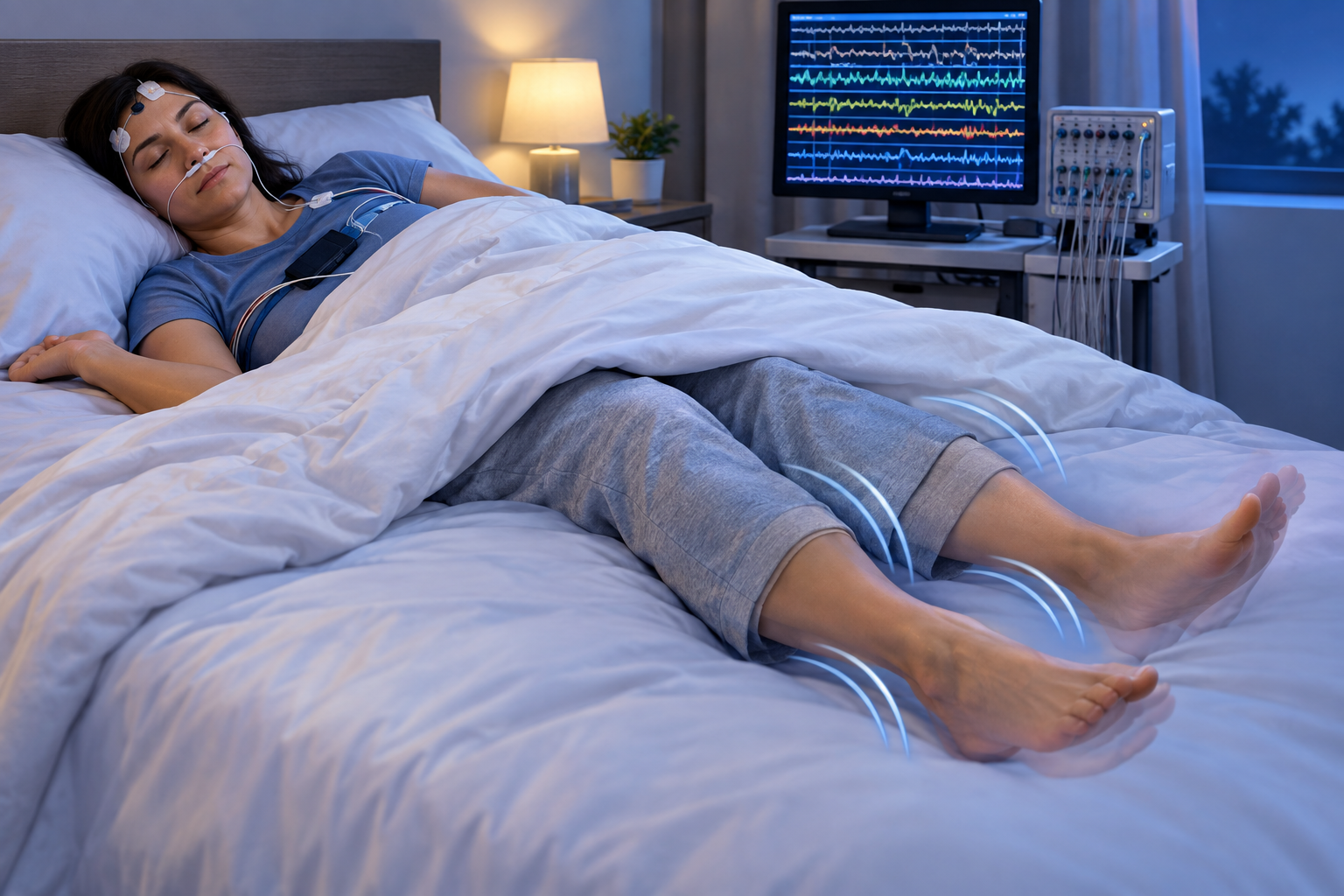
Periodic limb movement disorder (PLMD) [आवधिक अंग आंदोलन विकार] is a sleep disorder in which the patient moves limbs involuntarily and periodically during sleep and has symptoms or problems related to the movement. PLMD should not be confused with restless legs syndrome (RLS), which is characterized by a voluntary response to an urge to move legs due to discomfort. PLMD, on the other hand, is involuntary, and the patient is often unaware of these movements altogether. Periodic limb movements (PLMs) occurring during the daytime can be found but are considered a symptom of RLS; only PLMs during sleep can suggest a diagnosis of PLMD.
Diagnosis of PLMD cannot be used when narcolepsy, restless legs syndrome (RLS), REM sleep behavior disorder (RBD), or untreated obstructive sleep apnea (OSA) is already diagnosed, since abnormal movements during sleep are frequent in these disorders.
What Is Periodic Limb Movement Disorder?
Periodic Limb Movement Disorder (PLMD) is characterized by repetitive, involuntary limb movements that occur during sleep.
The movements most often affect the lower legs. A typical movement can involve extension of the big toe and bending of the ankle, knee, or hip. In some cases, movements can also involve the arms.
These movements may occur repeatedly during the night. Some people experience brief arousals, while others may not be aware of the movements.
PLMD is considered a diagnosis of exclusion. This means that healthcare professionals first look for other conditions that could explain the movements or sleep disruption, such as restless legs syndrome (RLS), obstructive sleep apnea, narcolepsy, or REM sleep behavior disorder.
PLMS vs PLMD
These two terms are often confused.
Periodic Limb Movements of Sleep (PLMS) describe the actual repetitive movements occurring during sleep.
Periodic Limb Movement Disorder (PLMD) refers to a clinical disorder in which these movements are associated with sleep disturbance or daytime problems and other explanations have been ruled out.
This distinction is important because simply finding limb movements during a sleep study does not automatically mean that a person has PLMD.
What Do Periodic Limb Movements Look Like?
Periodic limb movements may appear as:
- Repeated leg jerking
- Kicking movements
- Toe movements
- Ankle flexing
- Knee or hip movements
- Occasional arm movements
- Repetitive twitching during sleep
The movements may occur at intervals during the night. Cleveland Clinic notes that movements may occur roughly every 20 to 40 seconds in some people.
Because the person is asleep, they may not notice the movements themselves. A partner or family member may be the first person to notice them.

Symptoms of Periodic Limb Movement Disorder
The symptoms of PLMD can vary from one person to another. Some people mainly experience disturbed sleep, while others develop noticeable daytime problems.
Common symptoms may include:
Repetitive Leg Movements
The most characteristic feature is repeated involuntary movement of the legs during sleep.
Frequent Awakenings
Movements may cause brief arousals or awakenings, reducing sleep continuity.
Poor Sleep Quality
Even if someone spends enough hours in bed, repeated disturbances may prevent restorative sleep.
Daytime Sleepiness
Poor sleep may lead to tiredness or sleepiness during the daytime.
Fatigue
A person may feel physically and mentally tired after apparently getting a full night’s sleep.
Difficulty Concentrating
Sleep disruption may affect attention, concentration, and daytime performance.
Irritability or Mood Changes
Poor-quality sleep can contribute to irritability and changes in mood.
Importantly, some people with periodic limb movements have no noticeable symptoms. Finding PLMS on a sleep study does not automatically establish PLMD.
What Causes Periodic Limb Movement Disorder?
The exact cause of PLMD is not fully understood.
Researchers have suggested that abnormalities involving the nervous system may contribute to periodic limb movements. However, PLMS can occur in association with several other medical and sleep conditions.
Possible associated factors include:
- Restless legs syndrome
- Obstructive sleep apnea
- Narcolepsy
- REM sleep behavior disorder
- Kidney problems
- Anemia or low iron
- Certain neurological conditions
- Certain medications
- Family history of related sleep movement disorders
Some medicines, including certain antidepressants, antihistamines, and antipsychotic medications, may worsen periodic limb movements in some people.
Do not stop a prescribed medicine on your own. If you suspect that a medication is affecting your sleep, discuss it with your healthcare professional.
PLMD and Restless Legs Syndrome: What Is the Difference?
PLMD and Restless Legs Syndrome (RLS) are related but different conditions.
RLS usually involves an urge to move the legs while awake, often accompanied by uncomfortable sensations. Symptoms typically become worse during rest and in the evening or at night, and movement may provide temporary relief.
PLMD, on the other hand, refers to repetitive involuntary movements that occur during sleep.
There is an important connection between the two conditions. Periodic limb movements are very common in people with RLS. However, the presence of PLMS does not necessarily mean that someone has PLMD.
This is one reason why professional evaluation is important.
Who Is at Risk of PLMD?
Periodic limb movements can occur in adults and children, although PLMD itself is considered uncommon.
Factors that may be associated with periodic limb movements include:
- Increasing age
- Iron deficiency or anemia
- Diabetes-related nerve problems
- Kidney disease
- Family history
- Certain medications
- Other sleep disorders
- Physical inactivity
Cleveland Clinic notes that periodic limb movements can occur in both adults and children and that PLMS are a relatively common finding during sleep studies.
Having a risk factor does not mean that a person definitely has PLMD.
How Is Periodic Limb Movement Disorder Diagnosed?
Diagnosis generally begins with a detailed medical and sleep history.
A healthcare professional may ask about:
- Sleep quality
- Daytime sleepiness
- Bedtime and waking times
- Leg or arm movements
- Snoring
- Breathing problems during sleep
- Medications
- Other medical conditions
- Restless legs symptoms
- Observations made by a bed partner
Overnight Sleep Study
An overnight polysomnography (sleep study) is an important test when PLMD is suspected.
During polysomnography, different body functions are monitored while the person sleeps. Depending on the study, monitoring can include brain activity, eye movements, muscle activity, breathing, heart rate, oxygen levels, and limb movements.
The American Academy of Sleep Medicine’s guidance emphasizes polysomnography for evaluating suspected PLMD and assessing limb movements, related arousals, sleep architecture, and other possible sleep disorders.
In adults, a periodic limb movement index above 15 movements per hour of sleep is one part of the diagnostic criteria, but the number alone does not establish PLMD. Other causes and the clinical impact must also be considered.

Treatment for Periodic Limb Movement Disorder
Treatment depends on the underlying cause and whether the movements are actually producing clinically important sleep or daytime problems.
The first step is often to determine whether another condition is responsible.
Treat Underlying Conditions
If periodic limb movements occur because of another condition, treating that condition may be more important than treating the movements themselves.
For example, a healthcare professional may evaluate for:
- Restless legs syndrome
- Sleep apnea
- Iron deficiency
- Kidney disease
- Neurological conditions
- Medication-related effects
The 2024 AASM clinical practice guideline emphasizes that PLMD is a diagnosis of exclusion and that other sleep, medical, neurological, and psychiatric conditions need to be considered.
Review Medications
Some medications can worsen periodic limb movements. A healthcare professional may review the medicines a person is taking and decide whether an alternative is appropriate.
Never change or discontinue prescription medication without professional advice.
Medicines
There is considerably less high-quality evidence specifically for PLMD than for restless legs syndrome. The AASM’s recent guideline highlights the limited evidence base for PLMD treatment.
Some medicines used for related sleep movement disorders may be considered in selected cases, but medication should be individualized by a qualified healthcare professional.
This is particularly important because medications used for RLS and related disorders can have significant side effects or long-term considerations.
Can Lifestyle Changes Help?
Lifestyle measures may support better sleep, although they should not be considered a guaranteed cure for PLMD.
Helpful habits include:
Maintain a Regular Sleep Schedule
Go to bed and wake up at approximately the same time each day.
Create a Comfortable Sleep Environment
Keep the bedroom quiet, dark, comfortable, and suitable for sleep.
Exercise Regularly
Regular daytime physical activity may support healthy sleep. Avoid very intense exercise close to bedtime if it makes it harder to fall asleep.
Limit Caffeine Late in the Day
Coffee, tea, energy drinks, and other caffeinated products may interfere with sleep in some people.
Avoid Excessive Alcohol
Alcohol can disturb normal sleep architecture even if it initially makes a person feel sleepy.
Keep a Sleep Diary
Recording bedtime, wake time, awakenings, daytime sleepiness, medications, caffeine intake, and observations from a bed partner can provide useful information for a healthcare professional.
Can PLMD Be Cured?
There is no single cure that works for everyone because PLMD can have different associated causes.
Some people may experience improvement when an underlying condition is identified and treated or when a contributing medication is reviewed.
Because PLMD is relatively uncommon as an isolated disorder and high-quality treatment research is limited, treatment needs to be individualized.
The goal is generally to identify the reason for the movements, improve sleep quality, and reduce meaningful daytime consequences.
Is Periodic Limb Movement Disorder Dangerous?
PLMD primarily becomes a concern when repetitive movements significantly disrupt sleep or cause daytime symptoms.
A person who repeatedly wakes during the night may develop persistent sleepiness, fatigue, or difficulty functioning during the day.
It is also important not to assume that every abnormal movement during sleep is PLMD. Other sleep disorders can produce similar problems and may require different treatment.
If movements are frequent, new, worsening, or associated with significant daytime sleepiness, professional assessment is appropriate.
When Should You See a Doctor?
Consider speaking with a healthcare professional if:
- Your sleep is repeatedly disturbed.
- A partner notices frequent kicking or jerking during sleep.
- You regularly feel tired despite getting enough time in bed.
- You have significant daytime sleepiness.
- You frequently wake during the night.
- You have symptoms of restless legs syndrome.
- You suspect a medication is affecting your sleep.
- Sleep problems are affecting work, driving, concentration, or daily activities.
A sleep specialist may be appropriate when the diagnosis is unclear or symptoms are persistent.
Conclusion
Periodic Limb Movement Disorder (PLMD) is a sleep-related condition involving repetitive, involuntary limb movements during sleep. Because many people are unaware that the movements are happening, a bed partner may notice the problem first.
PLMS and PLMD should not be treated as identical terms. Periodic limb movements can occur with conditions such as restless legs syndrome and other sleep disorders, while PLMD is a diagnosis that requires careful evaluation and exclusion of alternative causes.
If you regularly experience poor sleep, unexplained daytime tiredness, or repeated nighttime limb movements, discussing the symptoms with a healthcare professional can help identify the underlying problem. A sleep study may be recommended when PLMD is suspected.
Good sleep is an important part of overall health. Understanding unusual movements during sleep is the first step toward finding the right explanation and appropriate care.
Frequently Asked Questions About PLMD
1. What is Periodic Limb Movement Disorder?
PLMD is a sleep-related movement disorder involving repeated, involuntary movements of the limbs during sleep that are associated with clinically significant sleep or daytime problems after other causes have been excluded.
2. What are periodic limb movements?
Periodic limb movements are repetitive involuntary movements that occur during sleep, most commonly involving the legs.
3. Is PLMD the same as restless legs syndrome?
No. RLS mainly causes an urge to move the legs and uncomfortable sensations while awake, particularly during rest. PLMD involves repetitive movements during sleep.
4. Can you have PLMS without PLMD?
Yes. Periodic limb movements can occur without causing a disorder. PLMD requires clinical significance and exclusion of other explanations.
5. How is PLMD diagnosed?
A healthcare professional evaluates symptoms and other possible causes. An overnight polysomnography can measure limb movements and their relationship to sleep and arousals.
6. Can PLMD cause daytime sleepiness?
It can. Repeated movements and associated arousals may interfere with sleep and contribute to daytime fatigue or sleepiness.
7. Can medications cause or worsen periodic limb movements?
Some medications can worsen PLMS in certain people, including some antidepressants, antihistamines, and antipsychotic medicines. Medication changes should only be made with professional guidance.
8. Is PLMD common?
Periodic limb movements are relatively common findings during sleep studies, but isolated PLMD is considered uncommon. The true prevalence of PLMD is uncertain because it requires exclusion of other conditions.
9. Can lifestyle changes cure PLMD?
Lifestyle changes can support healthier sleep, but there is no evidence that lifestyle measures alone cure every case of PLMD. Treatment depends on the underlying cause and clinical circumstances.
10. Should I be concerned if my partner kicks during sleep?
Occasional movement during sleep is not necessarily PLMD. However, frequent repetitive movements accompanied by poor sleep, repeated awakenings, or daytime sleepiness should be discussed with a healthcare professional
Medical Disclaimer
This article is intended for general educational and informational purposes only. It is not a substitute for professional medical advice, diagnosis, or treatment. Do not start, stop, or change medicines or supplements based solely on this article. If you have persistent sleep problems or significant daytime sleepiness, consult a qualified healthcare professional or sleep specialist.
Reference: https://en.wikipedia.org/wiki/Periodic_limb_movement_disorder