
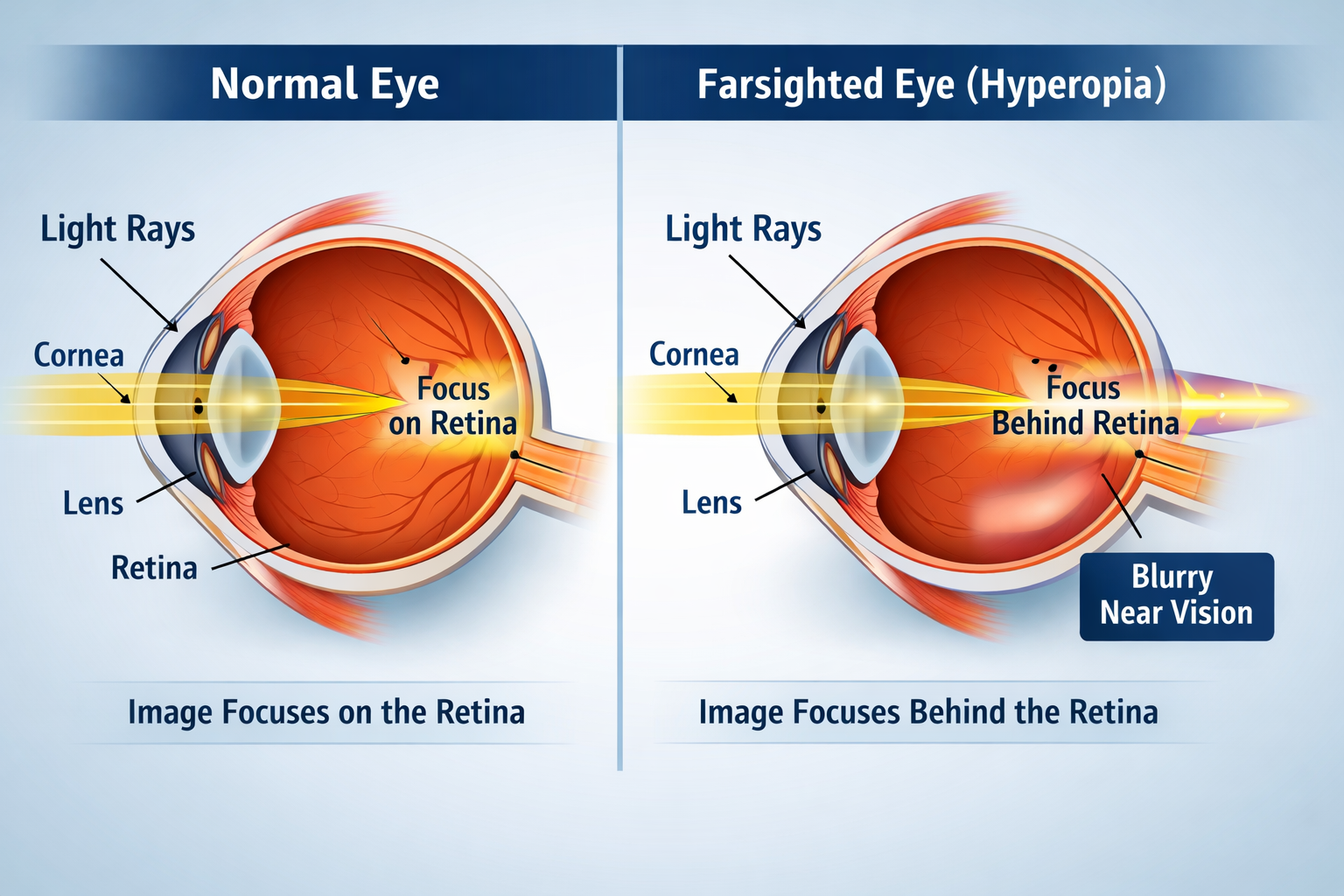
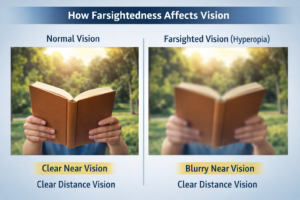
Farsightedness (दूरदृष्टि), also known as long-sightedness, hypermetropia, and hyperopia, is a condition of the eye where distant objects are seen clearly but near objects appear blurred. This blur results from incoming light being focused behind the retina rather than on it, due to insufficient accommodation by the lens. Minor hypermetropia in young patients is usually corrected by accommodation, without any visual defects. However, because of this accommodative effort for distance vision, people may experience eye strain during prolonged reading. If hypermetropia is severe, vision will be impaired at both distance and near. People may also experience accommodative dysfunction, binocular dysfunction, amblyopia, and strabismus. Newborns are almost invariably hypermetropic, but this gradually decreases as they age.
Farsightedness (Hyperopia): Complete Guide to Causes, Symptoms, and Treatment
Farsightedness, medically known as hyperopia, is one of the most common vision conditions, affecting millions worldwide. People with farsightedness can usually see distant objects clearly but struggle to focus on objects that are close, such as books, smartphones, or computer screens.
In many cases, hyperopia is present at birth due to the natural shape of the eye. Fortunately, modern eye care offers several effective treatments, including eyeglasses, contact lenses, and corrective eye surgery.
In this comprehensive guide, we will explore everything about farsightedness, including its causes, symptoms, diagnosis, treatment options, home care tips, and prevention strategies.
What Is Farsightedness?
Farsightedness (hyperopia) is a refractive error in which nearby objects appear blurry while distant objects appear clearer. It occurs when light entering the eye focuses behind the retina rather than directly on it, resulting in blurred near vision.
In a healthy eye, light rays pass through the cornea and lens and focus precisely on the retina. However, in hyperopia, the shape of the eye prevents proper focusing.
Many people are born with mild hyperopia and may not notice symptoms until later in life. In children and young adults, the eye muscles sometimes compensate for this condition, which may delay the onset of noticeable symptoms.
How Vision Normally Works
To understand farsightedness, it helps to understand how the eye focuses light.
The main parts involved in vision include:
-
Cornea: The transparent outer layer of the eye that bends light.
-
Lens: Adjusts its shape to focus light on the retina.
-
Retina: A light-sensitive layer that sends visual signals to the brain.
In normal vision:
-
Light enters through the cornea.
-
The lens fine-tunes the focus.
-
The image is projected directly onto the retina.
But in hyperopia, the light rays focus behind the retina, making close objects appear blurred.
Types of Farsightedness
Farsightedness can be classified into several types depending on its cause.
Axial Hyperopia
This occurs when the eyeball is shorter than normal, causing light rays to focus behind the retina.
Curvature Hyperopia
This happens when the cornea is flatter than usual, reducing the eye’s focusing power.
Index Hyperopia
This occurs when changes in the refractive index of the lens or the eye’s fluids alter the refraction of light.
Functional Hyperopia
This occurs when the eye’s focusing mechanism does not work properly.
Understanding the type of hyperopia helps ophthalmologists determine the most appropriate treatment.
Symptoms of Farsightedness
The symptoms of hyperopia may vary depending on severity and age. Some individuals with mild farsightedness may not notice any symptoms.
Common symptoms include
-
Blurry vision when looking at nearby objects
-
Eye strain during reading or computer use
-
Frequent headaches
-
Squinting to see clearly
-
Difficulty focusing on close work
-
Eye fatigue or a burning sensation
-
Double vision in some cases
These symptoms often become more noticeable during activities such as reading, writing, or using digital devices.
Children with farsightedness may also rub their eyes frequently or avoid reading tasks.
Causes of Farsightedness
Farsightedness primarily results from the shape of the eye. Several factors can contribute to this condition.
Short Eyeball
If the eyeball is shorter than normal, light rays focus behind the retina rather than directly on it.
Flat Cornea
A flatter cornea bends light less effectively, resulting in improper focusing.
Lens Problems
Changes in the lens shape may also affect the eye’s focusing ability.
Genetic Factors
Farsightedness often runs in families. If parents have hyperopia, children are more likely to develop it.
Risk Factors
Certain factors increase the likelihood of developing farsightedness.
Major risk factors include
-
Family history of hyperopia
-
Aging
-
Eye structure abnormalities
-
Developmental eye conditions
-
Other refractive errors
Hyperopia can affect people of all ages, but it becomes more noticeable with age as the eye’s focusing ability decreases.
Farsightedness in Children
Many babies are born with mild farsightedness because their eyes are still developing. In many cases, the condition improves as the eye grows.
However, severe hyperopia in children can lead to:
-
Crossed eyes (strabismus)
-
Lazy eye (amblyopia)
-
Learning difficulties due to blurred near vision
Regular eye examinations are essential for the early detection and treatment of hyperopia in children.
How Farsightedness Is Diagnosed
Eye doctors diagnose hyperopia through a comprehensive eye examination.
Common tests include:
Visual Acuity Test
Measures how clearly you can see letters on an eye chart.
Refraction Test
Determines the correct prescription for glasses or contact lenses.
Retinoscopy
Evaluates how light reflects off the retina.
Dilated Eye Examination
Allows the doctor to examine the internal structures of the eye. Eye exams are painless and usually take only a few minutes.
Treatment Options for Farsightedness
Fortunately, farsightedness can be corrected effectively with several treatments.
Eyeglasses
Prescription glasses are the most common treatment for hyperopia. Convex lenses help focus light properly onto the retina.
Benefits include:
-
Simple and affordable
-
Safe for all age groups
-
Immediate vision improvement
Contact Lenses
Contact lenses work similarly to eyeglasses but sit directly on the eye.
Advantages include:
-
Wider field of vision
-
More natural appearance
-
Convenient for active lifestyles
However, proper hygiene is essential to prevent infections.
Laser Eye Surgery
Laser procedures reshape the cornea to correct focusing errors.
Common surgeries include:
-
LASIK
-
PRK (Photorefractive Keratectomy)
-
LASEK
These procedures improve the eye’s ability to focus light correctly.
Lens Replacement Surgery
In some cases, doctors may implant an artificial intraocular lens (IOL) to improve vision.
This option is typically recommended for severe hyperopia or older patients.
Possible Complications of Farsightedness
If farsightedness remains untreated, it can lead to several problems.
Potential complications include
-
Eye strain
-
Frequent headaches
-
Reduced productivity
-
Crossed eyes in children
-
Learning difficulties
-
Poor quality of life
Early diagnosis and correction can prevent these complications.
Can Farsightedness Be Prevented?
Because hyperopia is typically associated with the natural shape of the eye, it cannot always be prevented.
However, good eye care habits can help maintain healthy vision.
Prevention tips include
-
Regular eye examinations
-
Maintaining proper reading distance
-
Using good lighting during reading
-
Taking breaks from screens
-
Eating eye-healthy foods
These habits help reduce eye strain and maintain overall eye health.
Eye Care Tips for People with Hyperopia
If you have farsightedness, the following lifestyle tips may help protect your vision.
Follow the 20-20-20 Rule
Every 20 minutes, look at something 20 feet away for 20 seconds.
Use Proper Lighting
Avoid reading in dim light to reduce eye strain.
Maintain Screen Distance
Keep digital screens about 20–24 inches from your eyes.
Eat Eye-Healthy Foods
Include foods rich in:
-
Lutein and zeaxanthin
Farsightedness vs Nearsightedness
| Feature | Farsightedness (Hyperopia) | Nearsightedness (Myopia) |
|---|---|---|
| Vision clarity | Far objects clearer | Near objects clearer |
| Focus point | Behind retina | In front of the retina |
| Main symptom | Blurry near vision | Blurry distant vision |
| Treatment | Glasses, contacts, surgery | Glasses, contacts, surgery |
Both conditions are refractive errors caused by the way light focuses inside the eye.
When to See an Eye Doctor
You should consult an eye specialist if you experience:
-
Persistent blurry vision
-
Frequent headaches
-
Difficulty reading
-
Eye fatigue
-
Squinting to see clearly
Early diagnosis ensures proper treatment and prevents complications.
Conclusion
Farsightedness (hyperopia) is a common refractive vision condition that makes it difficult to see nearby objects clearly. It usually occurs due to the natural shape of the eye, causing light to focus behind the retina rather than directly on it. While mild hyperopia may not cause noticeable symptoms, moderate or severe cases can lead to blurred vision, eye strain, and headaches.
The good news is that hyperopia is easily treatable with modern vision correction methods such as eyeglasses, contact lenses, and laser surgery. Early diagnosis through regular eye exams is crucial for maintaining clear vision and preventing complications.
By following healthy eye care habits and seeking professional guidance when needed, individuals with farsightedness can enjoy comfortable and clear vision throughout their lives.
FAQs About Farsightedness
1. What is farsightedness (hyperopia)?
Farsightedness, or hyperopia, is a common refractive error where distant objects appear clearer than nearby ones. It occurs when light entering the eye focuses behind the retina instead of directly on it. This makes it difficult to see close objects clearly.
2. What are the common symptoms of farsightedness?
Typical symptoms include blurred near vision, eye strain, headaches, and difficulty focusing on close tasks such as reading or using a smartphone. Some people may also experience tired or burning eyes after prolonged close work.
3. What causes farsightedness?
Farsightedness usually occurs when the eyeball is shorter than normal or the cornea is too flat. This structural difference prevents light from focusing correctly on the retina. Genetics can also play an important role in developing hyperopia.
4. Is farsightedness a serious eye condition?
Hyperopia is generally not considered a serious disease but a refractive vision problem. However, untreated severe farsightedness can lead to eye strain, headaches, or learning difficulties in children. Proper vision correction usually resolves these issues.
5. Can children have farsightedness?
Yes, many children are naturally born with mild farsightedness because their eyes are still developing. In many cases, the condition improves as the eye grows. However, regular eye exams are important to detect severe cases early.
6. How is farsightedness diagnosed?
Eye doctors diagnose hyperopia through a comprehensive eye examination. Tests such as visual acuity, refraction, and retinal evaluation help determine how well the eyes focus light and what correction is needed.
7. Can farsightedness be corrected?
Yes, farsightedness can be corrected with prescription eyeglasses, contact lenses, or refractive surgery. These treatments help focus light properly on the retina, allowing clear vision for both near and distant objects.
8. Is laser eye surgery effective for hyperopia?
Laser eye surgeries such as LASIK or PRK can effectively treat many cases of hyperopia. These procedures reshape the cornea to improve the eye’s focusing ability. However, not everyone is a suitable candidate, so an eye doctor must evaluate eligibility.
9. Does farsightedness worsen with age?
In some cases, farsightedness may become more noticeable with age due to reduced focusing ability of the eye. Age-related vision changes, such as presbyopia, can also make near vision more difficult over time.
10. How often should I have an eye examination?
Most adults should have a comprehensive eye exam every one to two years. Regular checkups help detect vision changes early and ensure that your glasses or contact lens prescription remains accurate.
Reference: https://en.wikipedia.org/wiki/Farsightedness
Comment