
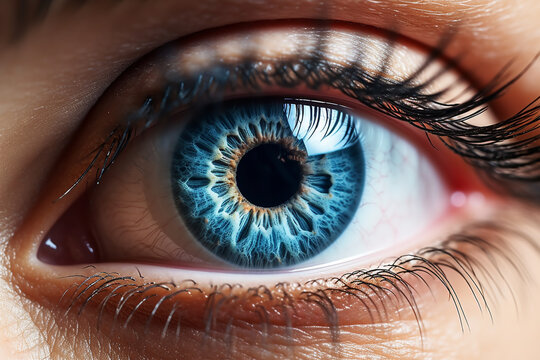
The human eye (मनुष्य की आंख) is a sensory organ in the visual system that responds to visible light, enabling vision. It is one of the most complex and fascinating organs of the body. It allows us to perceive light, colors, depth, and motion, enabling us to interact with the surrounding world. Often compared to a highly advanced camera, the eye captures visual information and sends it to the brain, where it is processed into images we understand. From reading and driving to recognizing faces and appreciating beauty, vision plays a crucial role in daily life. Understanding the structure and function of the human eye helps us appreciate its importance and take better care of our vision.
What Is the Human Eye?
The human eye is a sensory organ responsible for vision. It detects light and converts it into electrical signals that are transmitted to the brain through the optic nerve.
Key Functions of the Human Eye
-
Detects light and darkness
-
Differentiates colors
-
Identifies shapes and sizes
-
Provides depth perception
-
Enables motion detection
The eye works in coordination with the brain, making vision both a physical and neurological process.
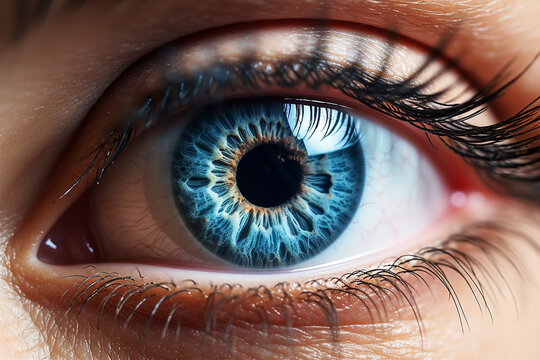
Anatomy of the Human Eye
The anatomy of the human eye can be divided into external structures and internal structures. Each part has a specific role in vision.
External Parts of the Human Eye
Eyelids
Eyelids protect the eye from dust, injury, and excessive light. Blinking spreads tears evenly, keeping the eye moist and clean.
Eyelashes
Eyelashes prevent dust, sweat, and small particles from entering the eye and trigger a blink reflex when touched.
Eyebrows
Eyebrows divert sweat and rain away from the eyes, enhancing protection.
Tear Glands (Lacrimal Glands)
These glands produce tears that lubricate the eye, wash away debris, and provide antibacterial protection.
Internal Structure of the Human Eye
Sclera
The sclera is the white outer layer of the eye. It maintains the shape of the eyeball and provides protection.
Cornea
The cornea is the transparent front part of the eye. It plays a vital role in focusing light onto the retina and contributes most of the eye’s refractive power.
Conjunctiva
The conjunctiva is a thin, transparent membrane covering the sclera and inner eyelids. It protects the eye and keeps it moist.
Iris
The iris is the colored part of the eye. It controls the amount of light entering the eye by adjusting pupil size.
Pupil
The pupil is the black circular opening in the center of the iris. It expands in dim light and contracts in bright light.
Lens
The lens is a transparent, flexible structure behind the pupil. It focuses light onto the retina and changes shape to see near and distant objects (accommodation).
Retina and Vision Cells of the Human Eye
Retina
The retina is a light-sensitive layer at the back of the eye. It converts light into nerve impulses.
Rod Cells
Rod cells are responsible for night vision and peripheral vision. They work well in low light but do not detect color.
Cone Cells
Cone cells enable color vision and sharp visual detail. They function best in bright light.
Optic Nerve and Visual Pathway
The optic nerve carries visual signals from the retina to the brain. These signals are processed in the visual cortex of the brain, where images are formed.
Damage to the optic nerve can result in partial or complete vision loss.
How the Human Eye Works (Step-by-Step)?
-
Light enters the eye through the cornea
-
The cornea bends (refracts) light
-
Light passes through the pupil
-
The lens further focuses light
-
Light reaches the retina
-
Rods and cones convert light into signals
-
Signals travel through the optic nerve
-
The brain interprets the image
This entire process occurs in fractions of a second.
Human Eye and Color Vision
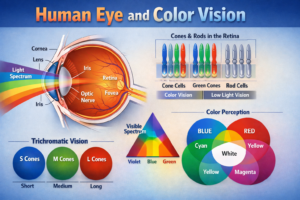
Color vision occurs due to three types of cone cells sensitive to:
-
Red light
-
Green light
-
Blue light
The brain combines signals from these cones to create millions of colors. Defects in cone cells can cause color blindness.
Depth Perception and Binocular Vision
Humans have binocular vision, meaning both eyes work together. This allows:
-
Accurate depth perception
-
Better judgment of distance
-
Improved visual clarity
Loss of binocular vision affects coordination and balance.
Common Human Eye Diseases and Disorders
Myopia (Nearsightedness)
A refractive error where near objects are clear but distant objects appear blurred in myopia-affected persons. It occurs when the eyeball is too long or the cornea is too curved.
Hyperopia (Farsightedness)
A condition in which distant objects are clearer than near ones in hyperopia. It happens when the eyeball is too short or the cornea has insufficient curvature.
Astigmatism
Caused by an irregularly shaped cornea or lens. Astigmatism leads to blurred or distorted vision at all distances.
Presbyopia
An age-related loss of the eye’s ability to focus on near objects. Presbyopia usually begins after the age of 40 due to stiffening of the eye lens.
Pseudomyopia
A temporary condition caused by excessive contraction of the ciliary muscle. Distant vision becomes blurred without permanent structural changes in Pseudomyopia.
Cataract
Clouding of the eye’s natural lens that reduces vision clarity. Cataract commonly develops with aging but can also result from diabetes or injury.
Glaucoma
A group of diseases that damage the optic nerve, often due to high eye pressure. If untreated, Glaucoma can cause irreversible vision loss or blindness.
Conjunctivitis (Pink Eye)
Inflammation of the conjunctiva caused by infection, allergy, or irritation. Conjunctivitis results in redness, itching, and discharge from the eye.
Dry Eye Disease
Occurs when the eyes do not produce enough tears or tears evaporate too quickly. Symptoms include burning, redness, and a gritty sensation.
Keratoconus
A progressive thinning and bulging of the cornea into a cone shape. Keratoconus causes distorted vision and increased light sensitivity.
Macular Degeneration (AMD)
A disease affecting the macula, the central part of the retina. Macular degeneration (AMD) leads to loss of central vision, especially in older adults.
Diabetic Retinopathy
A complication of diabetes that damages retinal blood vessels. Diabetic Retinopathy can cause vision impairment and blindness if not controlled early.
Retinal Detachment
A serious condition where the retina separates from its underlying tissue. Retinal detachment causes flashes, floaters, and sudden vision loss and requires urgent care.
Uveitis
Inflammation of the uvea (middle layer of the eye). Uveitis may cause pain, redness, blurred vision, and light sensitivity.
Blepharitis
Inflammation of the eyelid margins due to bacteria or gland dysfunction. Blepharitis leads to itching, crusting, and redness around the eyes.
Amblyopia (Lazy Eye)
Reduced vision in one eye due to abnormal visual development in childhood. Early treatment of Amblyopia is crucial to prevent permanent vision loss.
Strabismus (Squint)
A condition where the eyes do not align properly. Strabismus can lead to double vision or amblyopia if untreated.
Color Blindness
A genetic condition affecting color perception, most commonly red-green colors. Color blindness does not usually affect visual sharpness.
Common Human Eye Diseases – Summary Table
Mild Eye Diseases
(Usually manageable, low risk of permanent vision loss if treated early)
| Eye Disease | Brief Explanation (2–3 lines) |
|---|---|
| Conjunctivitis (Pink Eye) | Inflammation of the conjunctiva due to infection or allergy. Causes redness, itching, and discharge. |
| Dry Eye Disease | Occurs when tears are insufficient or evaporate quickly. Leads to burning, irritation, and discomfort. |
| Blepharitis | Inflammation of the eyelid margins caused by bacteria or gland dysfunction. Results in crusting and itching. |
| Color Blindness | A genetic condition affecting color perception. Does not usually impact visual sharpness or eye health. |
| Pseudomyopia | Temporary blurred distance vision caused by ciliary muscle spasm. Vision returns to normal with rest or treatment. |
Moderate Eye Diseases
(Can affect daily life and vision quality; requires regular monitoring and correction)
| Eye Disease | Brief Explanation (2–3 lines) |
|---|---|
| Myopia (Nearsightedness) | Clear near vision with blurred distant vision. Caused by an elongated eyeball or corneal curvature. |
| Hyperopia (Farsightedness) | Difficulty focusing on near objects. Occurs due to a shorter eyeball or flat cornea. |
| Astigmatism | Irregular cornea or lens causes distorted vision. Affects vision at all distances. |
| Presbyopia | Age-related loss of near focusing ability. Begins due to reduced lens flexibility after 40 years. |
| Strabismus (Squint) | Misalignment of the eyes. Can cause double vision or lazy eye if untreated. |
| Amblyopia (Lazy Eye) | Reduced vision in one eye due to abnormal childhood development. Early treatment is critical. |
| Keratoconus | Progressive thinning of the cornea leading to cone-shaped bulging. Causes increasing visual distortion. |
Severe / Vision-Threatening Eye Diseases
(High risk of permanent vision loss or blindness without timely treatment)
| Eye Disease | Brief Explanation (2–3 lines) |
|---|---|
| Cataract | Clouding of the eye’s natural lens. Causes progressive vision loss and requires surgery. |
| Glaucoma | Optic nerve damage, often due to high eye pressure. Can cause irreversible blindness if untreated. |
| Macular Degeneration (AMD) | Degeneration of the macula affects central vision. Common in older adults. |
| Diabetic Retinopathy | Diabetes-related damage to retinal blood vessels. Can lead to severe vision loss or blindness. |
| Retinal Detachment | Separation of the retina from its support tissue. A medical emergency causing sudden vision loss. |
| Uveitis | Inflammation of the uvea that may damage multiple eye structures. Can cause permanent vision impairment. |
Importance of Eye Care
Healthy eyes are essential for quality of life. Neglecting eye health can lead to permanent vision problems.
Key Benefits of Eye Care
-
Prevents vision loss
-
Detects diseases early
-
Maintains visual clarity
-
Improves productivity
Tips to Keep the Human Eye Healthy
-
Eat vitamin-rich foods (A, C, E, zinc)
-
Follow the 20-20-20 rule for screen use
-
Wear protective eyewear
-
Avoid smoking
-
Get regular eye checkups
-
Maintain proper lighting while reading
Human Eye in Children vs Adults
Children’s eyes are still developing and are more adaptable, while adult eyes gradually lose flexibility. Early detection of vision issues in children is critical for normal visual development.
Aging and the Human Eye
With age, changes such as:
-
Reduced tear production
-
Lens stiffening
-
Slower pupil response
become common. Regular eye exams are essential after age 40.
Interesting Facts About the Human Eye
-
The eye can distinguish about 10 million colors
-
Eye muscles are among the fastest muscles in the body
-
Each eye has a unique iris pattern
-
Blinking occurs about 15–20 times per minute
Human Eye vs Camera: A Comparison
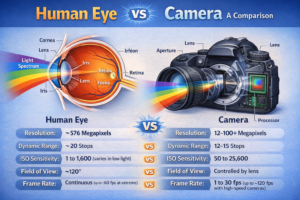
| Feature | Human Eye | Camera |
|---|---|---|
| Lens | Flexible | Fixed |
| Retina | Light-sensitive cells | Image sensor |
| Focus | Automatic | Manual/auto |
| Processing | Brain | Processor |
The eye remains far more adaptable than any camera.
Conclusion
The human eye is an extraordinary sensory organ that enables us to perceive the world through light, color, depth, and movement. Its intricate structure—comprising the cornea, lens, retina, and optic nerve—works in perfect coordination with the brain to create vision. Understanding the anatomy and function of the human eye helps us appreciate how delicate and powerful this organ truly is.
With the growing use of digital screens and increasing eye-related disorders, maintaining good eye health has become more important than ever. Regular eye checkups, a nutrient-rich diet, proper screen habits, and timely treatment of vision problems can prevent many eye diseases and preserve clear eyesight.
By learning about the structure, working, and care of the eye, we take the first step toward protecting our vision for a lifetime. Healthy eyes not only improve quality of life but also enhance productivity, safety, and overall well-being. Vision is precious—nurturing and protecting it should be a lifelong priority.
Frequently Asked Questions
1. What is the main function of the human eye?
The main function of the eye is to enable vision by detecting light and converting it into electrical signals that are sent to the brain, where they are interpreted as images.
2. How many parts does the human eye have?
The eye has several parts, broadly divided into external parts (eyelids, eyelashes, tear glands) and internal parts (cornea, iris, pupil, lens, retina, optic nerve), all working together for vision.
3. What role does the retina play in vision?
The retina is a light-sensitive layer at the back of the eye. It contains rod and cone cells that convert light into nerve impulses, which are then transmitted to the brain via the optic nerve.
4. What is the difference between rods and cones?
Rod cells help in low-light and night vision but do not detect color. Cone cells are responsible for color vision and sharp visual detail in bright light.
5. How does the human eye see colors?
Color vision occurs through three types of cone cells that respond to red, green, and blue light. The brain combines these signals to produce a wide range of colors.
6. What is accommodation in the human eye?
Accommodation is the process by which the eye lens changes its shape to focus on near and distant objects. This ability decreases with age, leading to presbyopia.
7. What are the most common vision problems of the human eye?
Common vision problems include myopia (nearsightedness), hyperopia (farsightedness), astigmatism, and presbyopia. These are usually corrected with glasses, contact lenses, or surgery.
8. How does the human eye protect itself?
The eye protects itself through blinking, tears, eyelashes, eyelids, and the conjunctiva, which help prevent dust, microbes, and harmful substances from causing damage.
9. How can we keep the human eye healthy?
Eye health can be maintained by eating a balanced diet, limiting screen time, wearing protective eyewear, avoiding smoking, and getting regular eye checkups.
10. Can the human eye heal itself?
The eye has a limited self-healing ability. Minor injuries to the cornea may heal on their own, but serious eye damage or diseases usually require medical treatment.
Reference: https://en.wikipedia.org/wiki/Human_eye