
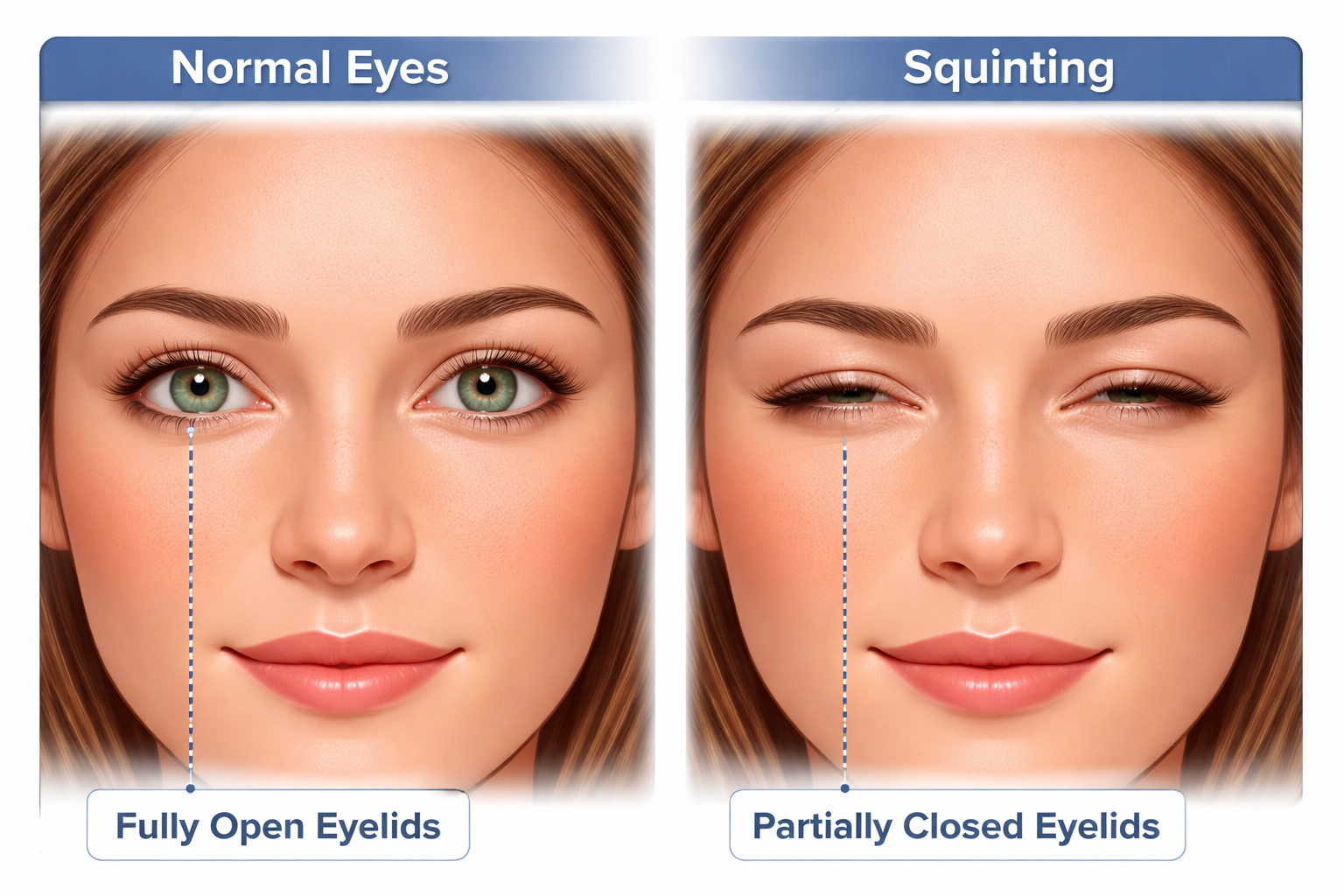
Squinting (आधी बंद आँखों से देखना) is the action of looking at something with partially closed eyes. Squinting is most often practiced by people who suffer from refractive errors of the eye who either do not have or are not using their glasses. It helps momentarily improve their eyesight by slightly changing the shape of the eye to make it rounder, which helps light properly reach the fovea. It also decreases the amount of light entering the eye, making it easier to focus on what the observer is looking at by removing rays of light that enter the eye at an angle and would need to otherwise be focused by the observer’s faulty lens and cornea. Pinhole glasses, which severely restrict the amount of light entering the cornea, have the same effect as squinting.
Squinting – The Science Behind Looking with Partially Closed Eyes
Squinting is the action of looking at something with partially closed eyes—a behavior most people experience daily, often without realizing it. Whether you’re trying to read a distant sign, dealing with bright sunlight, or struggling with blurry vision, squinting is your eyes’ natural attempt to improve clarity. But is squinting harmless, or is it a warning sign of underlying eye problems?
In this comprehensive guide, we’ll explore everything you need to know about squinting—from its causes and benefits to risks, treatments, and prevention tips.
What Is Squinting?
Squinting refers to narrowing the eyelids to partially close the eyes to see more clearly or reduce discomfort. It is a natural visual response that helps the eyes focus better by limiting the amount of incoming light.
Scientifically, squinting creates what is known as a “pinhole effect”, where only central light rays enter the eye, reducing blur and improving focus. This effect is similar to how a camera works—when the aperture is smaller, the image becomes sharper.
Why Do We Squint? (The Science Explained)
The Pinhole Effect
When you squint, your eyelids act like a small aperture:
-
Blocks scattered light rays
-
Allows only focused light to reach the retina
-
Improves image sharpness temporarily
This optical phenomenon is why objects appear clearer when you squint.
Reduction of Light and Glare
Squinting reduces the amount of light entering your eyes, which:
-
Minimizes glare
-
Protects from bright sunlight
-
Improves comfort in high-light environments
This is why people instinctively squint outdoors or under harsh lighting.
Compensation for Vision Problems
Squinting often occurs when your eyes struggle to focus properly due to refractive errors, such as:
It temporarily compensates for these issues but does not correct them permanently.
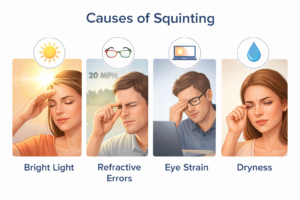
Common Causes of Squinting
Squinting can be triggered by various environmental, visual, and medical factors.
Refractive Errors
Uncorrected vision problems are the most common cause of squinting. When your eyes cannot focus clearly, squinting becomes a quick “fix.”
Bright Light (Photophobia)
Exposure to sunlight, screens, or strong artificial lighting causes reflex squinting to reduce discomfort.
Eye Strain and Fatigue
Prolonged screen use or reading can lead to:
-
Tired eye muscles
-
Blurry vision
Squinting helps temporarily relieve these symptoms.
Dry Eyes
Insufficient tear production can cause irritation and blurred vision, leading to squinting as a coping mechanism.
Allergies and Irritants
Dust, pollen, or smoke can irritate the eyes, causing redness and involuntary squinting.
Eye Conditions (Strabismus)
Sometimes, squinting refers to a medical condition called strabismus, where the eyes are misaligned and do not focus on the same object.
Is Squinting Good or Bad for Your Eyes?
The Good Side
Squinting can actually be helpful in certain situations:
-
Improves temporary vision clarity
-
Reduces glare and discomfort
-
Acts as a natural protective reflex
The Limitations
However, squinting is not a solution:
-
It does not correct underlying vision problems
-
It provides only temporary clarity
-
It can mask serious eye conditions
Does Squinting Damage Your Eyes?
The good news: Squinting itself does not cause permanent eye damage.
But frequent squinting can lead to:
-
Eye fatigue
-
Headaches
-
Reduced concentration
It’s a symptom—not the problem itself.
Signs That Squinting Indicates a Problem
Blurred or Double Vision
If you often squint to see clearly, it may indicate blurred or double vision caused by refractive errors or focusing issues. This means your eyes are struggling to form a sharp image, and squinting is only a temporary fix.
Frequent Headaches
Regular headaches, especially after reading or screen use, can be linked to eye strain from uncorrected vision problems. Squinting forces your eye muscles to work harder, which can trigger discomfort and tension headaches.
Eye Strain or Fatigue
If your eyes feel tired, heavy, or uncomfortable after visual tasks, it may be a sign of digital eye strain or overuse. Squinting in such cases is your eyes’ way of trying to improve focus despite fatigue.
Difficulty Seeing Distant or Near Objects
Struggling to see objects clearly—whether far away or up close—often points to conditions like myopia or hyperopia. Squinting may temporarily sharpen vision, but it indicates the need for proper correction.
Sensitivity to Light (Photophobia)
Excessive squinting in normal lighting conditions may signal light sensitivity. This can be due to dry eyes, inflammation, or other underlying eye conditions that make your eyes more reactive to light.
Misaligned Eyes
If one eye appears to turn inward, outward, upward, or downward, it may indicate an alignment issue. Squinting in such cases can be an attempt to improve focus, but it requires medical evaluation.
Watery or Irritated Eyes
Persistent tearing, redness, or irritation, along with squinting, may suggest dry eye syndrome or allergies. The discomfort makes it harder to keep the eyes fully open, leading to frequent squinting.
Trouble Focusing for Long Periods
If you find it hard to maintain focus during reading, driving, or screen work, your eyes may be under strain. Squinting helps briefly, but ongoing difficulty indicates a deeper visual issue.
Squinting in Children
Children who squint frequently may have undiagnosed vision problems or conditions like lazy eye. Early detection is crucial, as untreated issues can affect visual development and learning.
Needing to Sit Closer to Screens
If you frequently move closer to the TV or hold devices nearer to your face, it may indicate poor distance vision. Squinting in such situations is a sign that your eyes need proper evaluation.
Squinting in Children
It may indicate:
-
Undiagnosed vision problems
-
Lazy eye (amblyopia)
If untreated, it can lead to permanent vision issues and poor depth perception.

Diagnosis of Squinting
An eye specialist may perform:
-
Visual acuity test
-
Refraction test
-
Eye alignment test
-
Retinal examination
These tests help identify whether squinting is due to refractive errors or underlying eye conditions.
Treatment Options for Squinting
Prescription Glasses or Contact Lenses
Corrective lenses are the most common solution for refractive errors.
Eye Drops or Artificial Tears
Helpful for dry eyes and irritation.
Vision Therapy
Exercises to improve eye coordination and focus.
Surgery (for Strabismus)
In severe cases, surgery may be needed to correct eye alignment.
Lifestyle Changes
-
Reduce screen time
-
Improve lighting conditions
-
Wear sunglasses outdoors
-
Follow the 20-20-20 rule
How to Prevent Frequent Squinting
Here are practical tips to reduce squinting:
- Get Regular Eye Checkups
- Use Proper Lighting
- Wear Sunglasses Outdoors
- Take Screen Breaks
- Keep Eyes Hydrated
Preventive care is crucial to maintaining long-term eye health.
Squinting vs. Eye Disorders – Key Differences
| Feature | Squinting (Action) | Strabismus (Condition) |
|---|---|---|
| Nature | Temporary behavior | Medical disorder |
| Cause | Light, blur, strain | Muscle or nerve issues |
| Duration | Occasional | Persistent |
| Treatment | Usually none needed | Requires medical care |
Ayurveda Treatments for Squinting
Ayurveda views squinting (commonly linked to Strabismus) as an imbalance in the body’s doshas—primarily Vata affecting nerve and muscle coordination, along with Pitta (vision function) and Kapha (muscle stability). While Ayurveda may not “instantly correct” eye alignment like surgery or glasses, it focuses on strengthening eye muscles, improving nerve control, and supporting overall eye health.
Here’s a clear, practical guide to Ayurvedic treatments for squinting:
Netra Tarpana (Eye Nourishment Therapy)
This is one of the most important Ayurvedic eye therapies.
- Warm medicated ghee (usually Triphala ghrita) is retained over the eyes.
- It deeply nourishes eye tissues and improves muscle coordination.
- Helps reduce dryness, fatigue, and strain that can worsen squinting.
Best done under an Ayurvedic doctor’s supervision.
Herbal Medicines for Eye Strength
Ayurveda uses herbs that support vision and nerve function:
- Triphala: Improves overall eye health and detoxifies tissues.
- Brahmi: Enhances nerve coordination and brain-eye connection.
- Amla: Rich in Vitamin C, it supports vision and reduces eye strain.
- Shatavari: Balances Pitta and nourishes tissues.
These may be taken as powders, tablets, or medicated ghee—only with proper guidance.
Ayurvedic Eye Drops (Anjana / Aschyotana)
- Herbal eye drops made from natural extracts are used to cleanse and refresh eyes.
- They may help reduce irritation and improve focusing ability.
Avoid self-medicating—always use prescribed formulations.
Eye Exercises (Drishti Sadhana)
These are surprisingly effective when done consistently:
Trataka (Focused Gazing)
- Fix your gaze on a small object (like a candle flame).
- Improves focus and eye muscle coordination.
Eye Movement Exercises
- Move eyes up-down, left-right, diagonally.
- Helps strengthen weak eye muscles involved in squinting.
Palming
- Rub palms and place over closed eyes.
- Relaxes eye muscles and nerves.
Abhyanga (Head & Eye Massage)
- Gentle massage with medicated oils (like Brahmi oil).
- Improves blood circulation to the optic nerves and eye muscles.
Diet & Lifestyle (Very Important)
Ayurveda strongly emphasizes daily habits:
Eat more:
- Green leafy vegetables
- Carrots, beetroot
- Ghee (in moderation)
- Almonds and raisins
Avoid:
- Excess screen time
- Late-night habits
- Very spicy, oily, or processed food
Panchakarma Therapies
In chronic cases, detox therapies may be advised:
- Nasya (medicated nasal oil) – improves head and eye nerve function
- Shirodhara – calms the nervous system
- Virechana – balances Pitta affecting vision
Important Reality Check
Ayurveda can:
- Improve muscle strength
- Reduce eye strain
- Support mild cases (especially in children)
But for moderate to severe strabismus, combining Ayurveda with modern treatments (like glasses, vision therapy, or surgery) gives the best results.
Final Thought
Think of Ayurveda as a supportive and strengthening approach, not a quick fix. It works best with consistency, early intervention, and professional guidance.
Myths About Squinting
1: Squinting damages your eyes
Truth: It does not cause permanent damage.
2: Squinting improves eyesight permanently
Truth: It only provides temporary clarity.
3: Only children squint
Truth: People of all ages squint.
When Should You See a Doctor?
Consult an eye specialist if:
-
You squint frequently
-
Vision is blurry
-
You have eye pain or headaches
-
One eye appears misaligned
-
A child is squinting regularly
Early diagnosis can prevent serious complications.
Conclusion
Squinting is a common and natural response that helps your eyes temporarily improve focus by reducing scattered light and enhancing visual clarity. While it may seem harmless—and even helpful in situations like bright sunlight or mild blur—it is important to understand that squinting is not a solution, but rather a signal. In many cases, frequent squinting indicates underlying vision issues such as refractive errors, eye strain, or dryness that require proper attention.
Ignoring persistent squinting can lead to ongoing discomfort, headaches, reduced productivity, and even worsening vision problems over time. This is especially important in children, where early detection of vision issues can significantly impact learning and development. Recognizing the difference between occasional squinting and a recurring habit is key to maintaining long-term eye health.
The good news is that most causes of squinting are easily manageable. Regular eye checkups, proper lighting, limiting screen exposure, and using corrective lenses when needed can make a significant difference. By taking proactive steps and listening to what your eyes are telling you, you can protect your vision and ensure clearer, more comfortable sight in everyday life.
Frequently Asked Questions
1. Why do I see better when I squint?
Squinting reduces the amount of scattered light entering your eyes, creating a “pinhole effect.” This helps focus light more precisely on the retina, making objects appear temporarily clearer. However, it does not fix the underlying vision issue.
2. Is squinting a sign that I need glasses?
Yes, frequent squinting often indicates refractive errors like myopia, hyperopia, or astigmatism. It’s your eyes’ way of compensating for blurry vision. An eye examination can confirm if corrective lenses are needed.
3. Can squinting damage my eyes?
Squinting itself does not cause permanent eye damage. However, doing it frequently can lead to eye strain, fatigue, and headaches. It’s better to address the root cause rather than rely on squinting.
4. Why do I squint in bright light?
Bright light can overwhelm your eyes, causing discomfort and glare. Squinting reduces the amount of light entering the eyes, helping improve comfort and visibility. This is a natural protective reflex.
5. Is squinting normal in children?
Occasional squinting in children can be normal, especially in bright light. However, frequent squinting may indicate vision problems like refractive errors or eye misalignment. Early evaluation is important to prevent complications.
6. Can screen time cause squinting?
Yes, prolonged screen use can lead to digital eye strain, dryness, and blurred vision. These issues often make people squint to see more clearly. Taking regular breaks can help reduce this effect.
7. How can I stop squinting naturally?
You can reduce squinting by improving lighting, wearing sunglasses outdoors, and following the 20-20-20 rule during screen use. Keeping your eyes hydrated and well-rested also helps minimize strain.
8. When should I see a doctor for squinting?
You should consult an eye specialist if squinting is frequent or accompanied by blurred vision, headaches, or eye discomfort. Early diagnosis helps prevent worsening vision problems.
9. Is squinting related to eye strain?
Yes, eye strain is a common cause of squinting. When your eyes are tired or overworked, squinting helps temporarily improve focus. Addressing the strain can reduce the need to squint.
10. Can squinting be a sign of a serious eye condition?
In some cases, yes. Persistent squinting may indicate conditions like strabismus or other vision disorders. If it continues or worsens, a professional eye checkup is essential.
Reference: https://en.wikipedia.org/wiki/Squint