
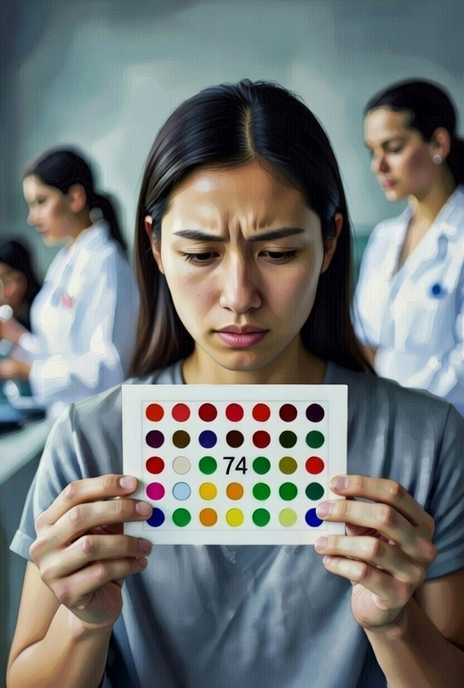
Color blindness (रंग अन्धता) or color vision deficiency (CVD) is the reduced ability to see colors, perceive color differences, or distinguish shades of color. The severity of color blindness ranges from mostly unnoticeable to full absence of color perception. Color vision deficiency is usually a sex-linked inherited problem or variation in the functionality of one or more of the three classes of cone cells in the retina, which mediate color vision. The most common form is caused by a genetic condition called congenital red–green color blindness (including protan and deutan types), which affects up to 1 in 12 males (8%) and 1 in 200 females (0.5%).
Diagnosis of color blindness is usually done with a color vision test, such as the Ishihara test. There is no cure for most causes of color blindness; however, there is ongoing research into gene therapy for some severe conditions causing color vision deficiency. Depending on the jurisdiction, color blind people are ineligible for certain careers, such as aircraft pilots, train drivers, police officers, firefighters, and members of the armed forces.
What Is Color Blindness?
Color vision deficiency occurs when the cone cells in the retina—responsible for detecting red, green, and blue light—don’t function properly. These cones allow us to perceive the full spectrum of colors. When one or more types are missing or faulty, color perception changes.
The term “color blindness” is somewhat misleading. Most people with the condition see colors, but certain hues appear muted, shifted, or indistinguishable. Only in rare cases (achromatopsia) do individuals see the world in grayscale.
The condition is usually genetic and present from birth, though acquired forms can develop later due to eye diseases, medications, or aging.
Meaning of color blindness is when the cone cells in the retina—responsible for detecting red, green, and blue light—don’t function properly.
Types of Color Blindness
There are several types, classified by which cones are affected:
- Red-Green Color Blindness (Most Common): Difficulty distinguishing reds and greens.
- Deuteranomaly (Mild green weakness): The most prevalent subtype.
- Protanomaly (Mild red weakness).
- Deuteranopia (Complete green absence).
- Protanopia (Complete red absence).
- Blue-Yellow Color Blindness (Tritanomaly/Tritanopia): Rare; trouble with blues and yellows.
- Complete Color Blindness (Achromatopsia/Monochromacy): Extremely rare; no color perception at all, often with light sensitivity.
Red-green types dominate, accounting for the vast majority of cases.
Symptoms and Daily Challenges
Symptoms of color blindness vary by severity but often include:
- Confusion between red/green or similar shades.
- Difficulty identifying colors in low light.
- Trouble with color-coded materials (maps, graphs, traffic signals).
Living with color blindness can affect:
- Career choices — Jobs in design, aviation, or electrical work may be restricted.
- Daily tasks — Matching clothes, cooking (e.g., judging meat doneness), or driving.
- Education — Interpreting charts or slides.
Many adapt well by adjusting brightness, context, or labels.
Symptoms and daily challenges of color blindness vary by severity but often include: Confusion between red/green or similar shades. Difficulty identifying colors in low light. Trouble with color-coded materials (maps, graphs, traffic signals).
Causes of Color Blindness
Most cases are inherited and linked to the X chromosome. Men have one X chromosome (from their mother), while women have two (one from each parent). This explains why it’s far more common in males—if a man inherits a faulty gene on his X chromosome, he develops the condition. Women need faulty genes on both X chromosomes, making it rarer.
Acquired color blindness can result from:
- Eye diseases (e.g., glaucoma, macular degeneration).
- Medications or chemicals.
- Brain injuries or conditions like diabetes.
How Is Color Blindness Diagnosed?
Diagnosis typically involves specialized tests during an eye exam:
- Ishihara Test: The most common screening tool. Plates show colored dots forming numbers or shapes visible only to those with normal vision or specific deficiencies.
- Other Tests: Farnsworth-Munsell 100 Hue Test, Anomaloscope, or Hardy-Rand-Rittler plates for detailed assessment.
Online versions are available for preliminary checks, but a professional evaluation is essential for accurate diagnosis.
Emerging Treatments and Research
Currently, no cure exists for inherited color blindness. However, promising research includes:
- Gene therapy — Early studies aim to restore faulty cone pigments.
- Advanced lenses and software filters for better simulation and correction.
Ongoing trials (as of 2026) explore retinal gene delivery, with potential breakthroughs on the horizon.
Prevalence: How Common Is Color Blindness?
Color blindness affects approximately 1 in 12 men (about 8%) and 1 in 200 women (0.5%), particularly in populations of Northern European descent. Globally, around 300 million people live with some form of color vision deficiency—roughly equivalent to the population of the United States.
Prevalence is lower in some ethnic groups (e.g., Asian or African populations show slightly reduced rates). Red-green deficiencies are the most common worldwide.
These figures highlight why awareness and accessibility matter—color vision issues impact a significant portion of society.
Living with Color Blindness: Tips and Adaptations
Many people discover their condition later in life and adapt effectively. Practical tips include:
- Using apps that identify colors via camera.
- Choosing high-contrast clothing or labeling items.
- Relying on patterns, shapes, or brightness instead of color.
- Advocating for color-blind-friendly designs (e.g., patterns on maps).
Specialized tools like color-correcting glasses (e.g., EnChroma) can enhance contrast for some, though results vary by type and severity.
Myths vs. Facts About Color Blindness
Myth: Color blind people see only black and white. Fact: True monochrome vision is extremely rare; most see a reduced palette.
Myth: It’s just confusing red and green. Fact: It affects many shades involving red/green components.
Myth: There’s no way to help. Fact: Assistive tools and design adaptations make a big difference.
Myth about Color Blindness: Color blind people see only black and white. Fact: True monochrome vision is extremely rare; most see a reduced palette.
Conclusion
Color blindness, or color vision deficiency, is more than just a minor inconvenience—it’s a condition that shapes how millions perceive the world around them. From its genetic roots to the daily adaptations required, understanding color blindness fosters empathy, innovation, and better design practices. While there’s no cure yet for inherited forms, advancements in technology like color-correcting lenses, apps, and gene therapy offer hope for improved quality of life.
By promoting awareness, we can create more inclusive environments in education, workplaces, and digital spaces, ensuring that color isn’t a barrier but a bridge to accessibility. If you or a loved one experiences symptoms, early diagnosis through tests like the Ishihara plates can make all the difference. Ultimately, color blindness reminds us that diversity in perception enriches our shared human experience—let’s continue to support research and accommodations for a brighter, more equitable future.
Frequently Asked Questions
1. What Exactly Is Color Blindness?
Color vision deficiency (CVD) is a condition where the cone cells in the retina have trouble detecting certain colors, most commonly reds and greens. Most people with it see colors but perceive them differently or as muted shades, not just black and white. It affects daily tasks like reading charts or matching clothes, but usually doesn’t impact overall vision sharpness.
2. What Are the Main Types of Color Blindness?
The most common type is red-green color vision deficiency, including deuteranomaly (mild green weakness), protanomaly (mild red weakness), deuteranopia (no green), and protanopia (no red). Rarer forms include blue-yellow (tritanomaly/tritanopia) and complete color blindness (achromatopsia/monochromacy), which shows the world only in grayscale. Red-green types account for over 99% of cases.
3. What Causes Color Blindness and Is It Hereditary?
In most of the cases, color vision deficiency is inherited through a faulty gene on the X chromosome, making it much more common in men than women. Acquired forms can develop later due to eye diseases, medications, diabetes, or aging. Genetic cases are present from birth and cannot be prevented, while managing health conditions may help avoid acquired types.
4. How Can I Tell If I Have Color Blindness?
Common signs include difficulty distinguishing reds from greens, blues from purples, or seeing muted shades where others see bright colors. You may struggle with traffic lights, color-coded maps, or matching outfits. An eye doctor can confirm it using the Ishihara test or other specialized plates during a routine exam.
5. Is Color Blindness More Common in Men or Women?
Color vision deficiency affects about 8% of men (1 in 12) but only 0.5% of women (1 in 200) worldwide. This difference occurs because the genes responsible are on the X chromosome—men have one X and are more likely to express the condition, while women usually need faulty genes on both X chromosomes.
6. Can Color Blindness Be Cured or Treated?
There is currently no cure for inherited color vision deficiency, but special glasses (like EnChroma) can improve color contrast for some people. Assistive apps, software filters, and design adaptations help manage daily challenges. Gene therapy research is progressing, but it is not yet widely available as of 2026.
7. How Does Color Blindness Impact Daily Life and Careers?
It can make tasks like driving, cooking, shopping for clothes, or interpreting graphs more difficult due to color confusion. Certain careers (aviation, graphic design, electrical work) may have restrictions or require special testing. Many people adapt successfully using labels, patterns, brightness cues, and technology.
8. What Tests Are Used to Diagnose Color Blindness?
The most common test is the Ishihara plate test, where you identify numbers or shapes hidden in colored dots. More detailed assessments include the Farnsworth-Munsell 100 Hue Test and the anomaloscope. Online versions give a preliminary idea, but only a professional eye exam provides an accurate diagnosis.
9. Are There Assistive Devices or Apps for Color Blindness?
Yes—color-correcting glasses, smartphone apps that identify colors via camera (e.g., Color Binoculars), and browser extensions help in real time. Operating systems like Windows and macOS offer built-in color filters, while AR tools and labeled tools improve accessibility for work, gaming, and education.
10. How Can Society Become More Inclusive for Color-Blind People?
Designers should use patterns, shapes, and labels alongside colors in maps, charts, websites, and signage. Schools and workplaces can adopt color-blind-friendly materials and offer accommodations. Raising awareness through campaigns and supporting research helps create an environment where color vision differences are no longer a barrier.
Reference: https://en.wikipedia.org/wiki/Color_blindness